Hijam Irabot, born on September 30, 1896, in Oinam Leikai, Imphal, and passing on September 26, 1951, in Tangbo, Burma (now Myanmar), is a towering name in Manipur. Known as Jana Neta (Leader of the People) or Lamyanba Irabot (Pioneer Irabot), he was a freedom fighter, communist leader, and social activist who shaped modern Manipur.
Beyond politics, he was a poet, journalist, and playwright whose works fueled cultural and revolutionary fervor. His early life was tough—orphaned young after losing his father, Hijam Ibungohal Singh, and mother, Chongtham Ningol Thambalngambi, he bounced between relatives, studying up to Class 7 at Johnstone Higher Secondary School in Imphal and briefly at Pugoj High School in Dhaka before dropping out due to financial woes.
Irabot’s literary output wasn’t just art—it was a weapon against oppression, a mirror to Manipuri society, and a call to action. Here’s a rundown of his key works:
- Meitei Chanu (1922) A handwritten magazine launched in 1922 when Irabot was just 26.
- Saidem Seireng (1929) A poetry collection, bought by the Manipur State Durbar on December 4, 1929. These poems weave Meitei folklore with a yearning for lost sovereignty, reflecting his growing discontent with British rule and the Maharaja’s feudal grip.
- Mohini (1931) A novel serialized in Yakairol monthly starting August 1931. A tale of human struggles and resilience.
- Dalil Amasung Darkhast Iba (1933)
- Imagi Puja (1942) A poetry collection written during his imprisonment in Sylhet Jail (1940–1943).
Irabot’s work is direct and grounded, using Meitei language (Meeteilon) to connect with the masses.
Manipuri literature, rooted in ancient texts like Numit Kappa (10th century), took a modern turn in the 20th century after setbacks like the 1729 burning of scriptures under Pamheiba. Alongside peers like Hijam Anganghal Singh (Khamba Thoibi Sheireng) and Khwairakpam Chaoba Singh (Lavangalata), Irabot helped redefine it. Unlike Anganghal’s epic grandeur or Chaoba’s poetic finesse, Irabot’s writing was utilitarian—literature as activism. He wasn’t just crafting art; he was arming minds, making him a unique voice in the modern resurgence.
Irabot’s literary legacy intertwines with his revolutionary one.
He married into royalty—Princess Khomdonsana, niece of Maharaja Churachand—but ditched perks like a Sadar Panchayat post to fight for the people.
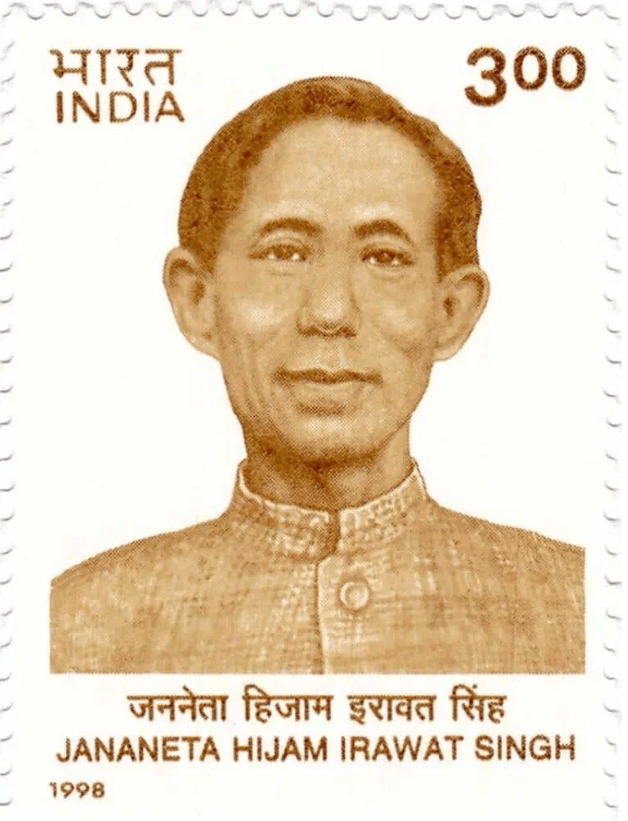
The Government of India released a postage stamp in honor of Hijam Irabot in 1998, recognizing his role as a freedom fighter and social reformer. This was part of a series celebrating notable Indian figures, a significant national acknowledgment of his contributions to the independence movement and Manipuri society.
Since 1976, the Manipur state government has declared September 30—Irabot’s birth anniversary—a state holiday or day of commemoration, often termed “Irabot Day”.
Library of Manipur is on a mission to create, preserve, promote and giving easy access to audio/video contents of Manipuri books and people of Manipur for generations to come.
Categories: People Of Manipur
 Library Of Manipur